



Browse Content



Life Worth Living is an initiative of the Yale Center for Faith & Culture at Yale Divinity School.


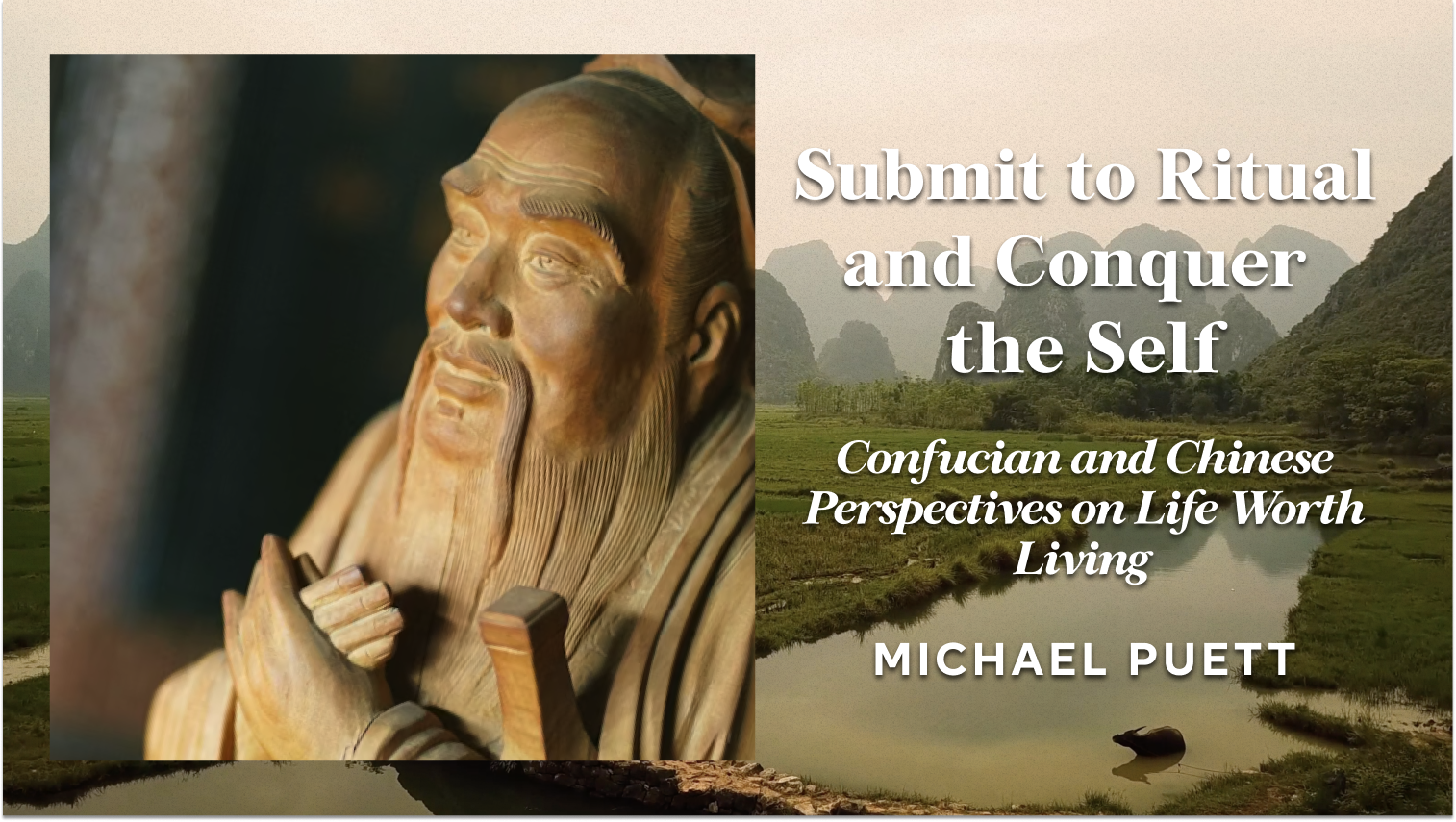
Submit to Ritual and Conquer the Self
Michael Puett is the Walter C. Klein Professor of Chinese History and Anthropology and the Victor and William Fung Foundation Director of the Asia Center at Harvard University.
"We may be allowing ourselves to become incredibly manipulatable figures precisely when we think we are being liberated."
Listen on
Michael Puett brings Confucius and classical Chinese philosophy to bear on identity, social media manipulation, and the patterns that quietly run our lives.
Harvard's Michael Puett challenges the modern imperative to "look within and find your true self." Speaking at Hong Kong University as part of the Life Worth Living series, Puett brings Confucius and classical Chinese philosophy to bear on identity, social media manipulation, and the patterns that quietly run our lives. Drawing on the Analects, Mencius, Xunzi, and Zhuangzi, he argues that "conquering the self by submitting yourself to ritual" may be modernity's most overlooked path to flourishing.
With special thanks to Daniel Chua, Jonathan Johnson, and the University of Hong Kong’s Life Worth Living Common Core.
Harvard's Michael Puett challenges the modern imperative to "look within and find your true self." Speaking at Hong Kong University as part of the Life Worth Living series, Puett brings Confucius and classical Chinese philosophy to bear on identity, social media manipulation, and the patterns that quietly run our lives. Drawing on the Analects, Mencius, Xunzi, and Zhuangzi, he argues that "conquering the self by submitting yourself to ritual" may be modernity's most overlooked path to flourishing.
With special thanks to Daniel Chua, Jonathan Johnson, and the University of Hong Kong’s Life Worth Living Common Core.
The Modern Myth of the True Self
- Puett opens with the dominant Western prescription: "Look within and find your true self."
- This shapes careers, dating apps, personality tests, and self-judgment.
- The provocation: "Maybe these ideas, in fact, are dangerous."
Classical Chinese Philosophy and the Self as Mess
- Confucius's teaching: "Conquer the self by submitting yourself to ritual."
- There is no fixed self at birth — only chi (qi), a swirl of energies and emotions.
- "You are a mess. You are a mess of different energies called chi."
Patterns, Personality, and the Cult of Authenticity
- Rote responses harden into what we mistake for personality.
- "If we were really, really, really going to do something intensely dangerous, we might even call them our true self."
- Friends repeat the same disastrous relationships; family patterns play out across generations.
- "Patterns are dangerous. Patterns are just endless repetitions."
Algorithms, Brexit, and Manufactured Desire
- Puett's "minimalist watch" story: a Friday-5:19pm ad tuned to mapped click patterns.
- The same logic helped move the Brexit vote and now powers electoral microtargeting.
- "We may be allowing ourselves to become incredibly manipulatable figures precisely when we think we are being liberated."
Ritual as Role Reversal
- An ancient Chinese ritual: a king becomes the son; his son becomes the grandfather-ruler.
- The reversal forces participants to feel the world from the opposite perspective.
- Repeated ritual builds the capacity to sense and shift patterns outside ritual space.
Becoming Good and the Joy of Resonance
- "Becoming good" is captured in the Analects through joy — the same character as music.
- Confucius walks into a room, senses the patterns, and shifts them with a line of poetry.
- Zhuangzi extends resonance to plants, animals, and the cosmos.
Practical Applications for Modern Life
- Difficult parents: shift tones and roles to disrupt long-standing patterns.
- Mean colleagues: recognize you are part of the pattern, then experiment with new roles.
- Imagine a Spotify whose algorithm expands your taste rather than confines it.
- Even "good" patterns — workaholism, distant-but-stable marriages — need breaking.
Confucian Urgency and a Life Worth Living
- Confucianism offers no heaven, no rebirth, no afterlife reward — only this life.
- "We have, again, at best a few decades, which is an extraordinary vision."
- The mundane becomes existentially weighty.
About Michael Puett
Michael Puett is the Walter C. Klein Professor of Chinese History and Anthropology and the Victor and William Fung Foundation Director of the Asia Center at Harvard University. He holds a joint appointment in East Asian Languages and Civilizations and Anthropology, with research focused on the inter-relations between religion, history, anthropology, and philosophy. He is the co-author of the bestselling The Path: What Chinese Philosophers Can Teach Us About the Good Life.
Transcript
Thank you. It's an honor to be here. What I'd like to discuss today is the question of a life worth living — and I'll approach it by drawing on ideas that arose in Classical China, ideas I think we should take very seriously.
To set this up, let me begin with a few assumptions we tend to make about what it means to live well, particularly at your stage of life. In the United States — and I suspect this has spread globally — the dominant answer to how to live your life is fairly straightforward: look within. Find yourself. Find your true self.
We often tell ourselves this should happen even before college. You start the process of self-discovery early, and by the time you arrive at university, you can move to the next step: once you've begun to find yourself, you can identify the career that best fits your interests, your strengths, your passions — and choose a major that points you in that direction. If you follow this path, the thinking goes, you'll be living life on your own terms.
And it doesn't stop there. This same logic tells us how to judge ourselves and others. Not only should we live according to who we are — we should love and embrace who we are. Embrace your strengths, yes, but love your weaknesses too. "That's just me." We extend the same grace to others. If a friend loses his temper, we say, "That's just Herman being Herman." He was being true to himself, and that's okay.
We apply this framework to romantic relationships as well. Naturally, you want to find a true self that matches your true self — and we've built elaborate systems around this. Dating apps. Personality tests. Tools that identify your type and match you with compatible partners, or even compatible careers.
I'll use the words we often reach for to describe all of this: the way to live a true, wonderful, modern, liberated life.
We often contrast this with what we imagine "traditional societies" looked like — worlds where people performed rituals that told them who to be, where they were socialized into fixed roles. Unlike those people, we are free. We choose for ourselves. We are liberated.
So this all sounds great. Which may make it strange that I'm now going to argue we might be completely wrong — and not just wrong, but that these ideas may actually be dangerous. They may be limiting what we can do with our lives. And, ironically, even as we believe we're living freely, we may be making ourselves extraordinarily easy to manipulate.
Those are strong claims. But if there's anything to them, how would we gain a different perspective? I want to suggest that ideas from Classical China — radically different from what I've just described — offer a powerful critique of assumptions we've come to take for granted, and possibly a different way forward.
I'm going to start with a quotation that will sound, at first, like a perfect example of exactly the kind of traditional thinking we believe we've left behind. It's from Confucius. Here it is:
To become good, you must conquer the self by submitting yourself to ritual.
Conquer the self by submitting yourself to ritual. It sounds like the opposite of everything we've been told. I want to argue that Confucius may be profoundly right — and that working through this sentence, piece by piece, will reveal something important about how to live.
Conquer the Self
Why would we want to conquer the self? Why not look within, embrace who we are, and live accordingly?
In the Classical Chinese tradition, the self is understood very differently. At birth, you don't have a true self waiting to be discovered. What you have is something more like a mess. A mess of different energies — what the tradition calls chi — emotions, desires, faculties, impulses. We are all, equally, a mess of stuff. That's what it is to be human.
And then these messes called humans get born into the world and start interacting with things. Here's what happens. You're a baby, lying in your crib, and someone walks in and smiles at you. You feel happy. In this framework, that smile draws out from you the energy of happiness. Then someone walks in and yells at you. You feel angry.
So far, so good. But here's where it gets interesting — and troubling. Very quickly, we stop responding to what's actually happening and start responding by rote. That same smile reminds you of an earlier smile, and your chi of happiness gets pulled out even though nothing new has occurred. Someone else walks in and, for some reason, reminds you of the person who yelled — and you feel anger, even though that person hasn't done anything to warrant it.
We're no longer responding to the world. We're responding to patterns.
And it's not just emotions. These patterns slowly come to define how we act around others, how we form relationships, what we see — and what we fail to see — when we walk down a street. Years pass. The patterns deepen. They become so embedded in us that we begin, foolishly, to call them our personalities. Or worse: our true selves.
So when we say, "I tend to get angry under pressure — that's just me, and I love and accept that about myself," we may really be saying: "I've fallen into a set of patterns from an early age, and I've decided to call them my identity and build my life around them."
Patterns and Manipulation
Is this really an accurate picture of human beings? Let me offer a few examples.
You probably know someone who has the same relationship over and over again, regardless of who they're actually dating. First date goes wonderfully. By the third date, there's already tension. By the fourth, it's a disaster. Then they date someone new, and the exact same thing unfolds. They're not responding to a different person each time — they're running the same pattern.
Or consider family dynamics. Certain patterns play out over a lifetime — sometimes over generations — regardless of the individuals involved.
Now let me connect this to something even more immediate.
A few weeks ago, I bought a watch. A minimalist watch — no fancy details, just the hands. Very me. I felt it perfectly matched who I am, and I chose to buy it because it aligned with my true self.
Here's what actually happened.
It was Friday at 5:19 p.m. My workday was done. I opened my computer, went through the news, and gradually relaxed into more casual browsing. At exactly that moment — not 10 a.m., when I'm focused, not midday, but 5:19 — an ad appeared. A beautiful dark blue watch. I clicked. I bought it.
Algorithms had been tracking every website I'd visited, how long I lingered on each story, and which days and times I was most likely to click and buy. They knew what color catches my eye. They knew I'd recently bought a shirt of a similar minimalist style — also at 5:19 the week before. They weren't just tracing my patterns; they were actively working to keep me in them, because a patterned person is a manipulable person. If I started doing something unpredictable at 5:11 — watering my plants, putting down the screen — I'd break the spell. So the algorithm made sure the right story appeared to keep me scrolling until the moment of maximum susceptibility.
I didn't choose that watch. It was chosen for me, by an algorithm that understood my patterns better than I did — and used them against me, while I believed I was exercising my freedom.
This same logic operates at a much larger scale. Consider what we now know about how certain political campaigns have worked. People who rarely voted began receiving targeted content at the precise emotional moments when they were most responsive. Fears were activated. A sense of lost control was amplified. The message — "take back control" — landed just as the algorithm had predicted it would. Did those voters look within, find their true selves, and make a free choice? Or were they manipulated by systems that understood their patterns and exploited them?
So here is the bleak version of the picture: we believe we are liberated, autonomous individuals living according to our true selves. But we may be patterned creatures, repeating the same behaviors endlessly, while organizations that understand those patterns manipulate us at will.
If any of this is true — you don't want to love and embrace these patterns. You want to conquer them.
Submit Yourself to Ritual
This brings us to the second part of Confucius's phrase: submit yourself to ritual. And this might seem like the wrong answer. If the problem is that we're trapped in patterns, why would we want more patterns?
To understand what ritual means in this tradition, let me describe an example from ancient China.
You are a king. Your father has died, and you have inherited the throne. You have a son who will one day succeed you. There are the usual tensions: years of living in your father's shadow, never quite receiving the recognition you felt you deserved; and now, a son who seems to effortlessly win the affection of the court while you struggle to earn it. Typical family dynamics, in an extreme setting.
Here is the ritual. You and your son approach the edge of the ritual space. When you enter, everything reverses. You are now the son. Your son is now the father — your ruler. You must perform obeisance before your own child. Your son, meanwhile, sits in the position of authority, looking down at you, inhabiting the role of the one who holds power. Then the ritual ends. You walk back out. You are the father and ruler again. He is your son.
What is happening here?
You, who have spent years chafing under a father's authority and are now finally in power — are forced back into the position of subordination. You must look up at your own child and feel, viscerally and emotionally, what it means to be the one below. Not just intellectually — in your body. And your son, who has only ever been the young prince, is forced to inhabit the position of the ruler and feel, from the inside, the dynamics that drive the arrogance and insecurity of those who hold power.
Each sees the world from the perspective of the person with whom they have the most difficult relationship. Each begins to sense that what has seemed like the natural order — the way things simply are — is actually a set of patterns. Patterns that feel inevitable but are, in fact, changeable.
This is only one ritual among many. These role reversals are practiced repeatedly, with different members of the family, across years. Over time, you stop needing the ritual to prompt the insight. You begin to see patterns operating in real time — and you begin to sense what you can do to shift them.
Becoming Good
This brings us to the third part of the phrase: becoming good. The Chinese term is variously translated as goodness, benevolence, or humaneness — there is no perfect English equivalent. But its meaning becomes clear through how Confucius himself is described in the Analects.
One word comes up again and again in descriptions of Confucius: joyous. The Chinese character for joy is the same as the character for music. This is not accidental. Think of what great music does — it takes disparate elements and brings them into resonance. Not by forcing them into conformity, but by drawing out from each its particular quality so that, together, they create something that couldn't have existed otherwise. That's what Confucius does when he walks into a room.
He senses the patterns at play. He quotes a line of poetry. He adjusts the seating. He says the thing that shifts the dynamic — and the room changes. People stop responding by rote and begin actually responding to one another.
By this stage, Confucius is not consciously running through a ritual checklist. The training has become second nature. He has developed, through a lifetime of practice, the capacity to read a situation and do what needs to be done. He does this at the level of an ordinary room, and the tradition implies he could do it at the level of whole societies — breaking political and social patterns that have calcified over centuries.
What This Means for Us
We don't have role-reversal rituals. So what can we do?
Consider a difficult family dynamic — a parent who, out of genuine care, has slipped into telling you exactly what to do, and a child who alternates between resisting and secretly circumventing. This pattern can run for decades. Talking through it rarely breaks it, because the pattern operates at an emotional level that rational discussion doesn't reach.
The Confucian move is to shift the dynamic from within. In the middle of a familiar exchange, instead of pushing back, you change your tone entirely. You say: "I'm actually struggling with something right now. Could I get your advice?" You're not pretending — you're inviting a different role. Not the parent-who-commands and child-who-resists, but something more like a mentor and someone genuinely asking for guidance.
The first time you try this, they'll start to respond differently — then probably slide back into the old pattern. Do it again, a different way. Experiment. Notice what works and what doesn't. Within a few weeks, something that has felt immovable for decades will begin to shift. This sounds implausible, but it works.
The same applies to the person at work who seems aggressive or competitive. Instead of positioning yourself as a rival — which reinforces his pattern — you ask for help. You shift the role he's playing, and in doing so you access sides of him that his usual pattern never allows to surface.
And you can begin at the most mundane level. Train yourself to see more of your walk to campus. Notice the trees, the light, the architecture. In conversations, begin noticing the patterns playing out — not just in others, but in yourself. What are you doing that is genuinely responsive to this person, and what is rote?
This is training. It doesn't end in four years. It is a lifelong practice of expanding what you can see and what you can do.
What You Could Become
Here is what I want to suggest as an alternative to the "look within and find your true self" model.
What if most of what you think you are is simply an accurate description of what you currently are — but it's patterns, not identity? And what if those patterns, rather than being embraced and built upon, are the very thing to work against?
When you say, "I'm good at X and not good at Y, so I'll aim for careers that play to my strengths," you may be accurately describing your current patterns — but those patterns are not the ceiling of what you can become. The things you think you're bad at may be exactly the things you most need to train.
Instead of a life organized around discovering and expressing a fixed self, imagine a life organized around endless training — training to physically see more of the world, to sense the complexity of situations and relationships, to recognize the patterns you and those around you have fallen into, and to work with and through them.
From this would come skills and possibilities you cannot currently imagine. It would make possible real relationships — relationships based on actually responding to the other person, rather than running a script. And it would cultivate the kind of person who can genuinely change things, because you would have trained yourself to see the world as changeable rather than fixed.
This is what education means in the Analects. Not the transmission of information, and not the discovery of a pre-existing self. It is the ongoing work of becoming — and it doesn't end when you leave this room.
Ideas that arose 2,000 years ago in a so-called traditional society are not only still right — they may be among the most urgently needed perspectives available to us. If we open ourselves to them, they can challenge assumptions we've never thought to question and open possibilities we would otherwise never see.
Q&A
Moderator
Thank you, Professor Puett. For many students here in East Asia, the Analects are not unfamiliar — but what you've offered is a vision of the rites and rituals that often gets neglected in teaching. For students who don't have access to literal role-reversal rituals, are there practices you'd recommend that serve a similar function?
Michael Puett
Yes. We don't have those rituals, which is exactly what makes the question important. The goal is to live up to the philosophy behind them — and to find the equivalent in everyday life.
Take family dynamics. When you're stuck in a pattern with a domineering parent — one where they tell you what to do and you alternately resist or secretly comply — you do the equivalent of the role reversal. You shift the relationship. Mid-conversation, instead of pushing back, you say: "Actually, I'm going through something difficult right now. Can you help me think through it?" You're calling on them to be not the authority figure, but the experienced friend — someone who can empathize and advise rather than command. The first time you try this, they'll begin to respond differently. They'll probably slide back quickly. Try it again, differently. Keep experimenting. Within weeks, a pattern that has dominated for twenty years begins to shift.
You can also start simply. Train yourself on your walk to campus to actually see what's around you. The architecture, the trees, how the light falls. Begin noticing dynamics in conversations. Start sensing what's operating beneath the surface in the situations you move through every day. That attentiveness is the beginning of the practice.
Student Question
Is it the act of shifting patterns that brings joy, or the result?
Michael Puett
The joy comes when you begin genuinely resonating with others — not just recognizing that patterns exist. Shifting perspective is the necessary first step; it lets you see that a relationship is patterned and changeable. But the joy itself comes when you actually begin to connect with people differently. Imagine music: the insight that disparate notes can be brought into harmony is not yet the music. The joy is in the resonance itself. And once you begin to experience it, you'll realize how rare genuine connection is — even when we're surrounded by people all the time. When it happens, it's extraordinary.
The philosopher Zhuangzi, writing after Confucius, pushed this further. He argued that Confucius was right about all of this but too focused on the human realm. Zhuangzi extended the same principle to everything — writing a book in which the reader inhabits the perspective of a bird, a frog, a turtle. His point: the resonance doesn't have to stop with other people. Imagine developing that same quality of attentiveness toward the rest of the living world. That, too, is what joy can become.
Student Question
Could there be value in combining both the Confucian and the "true self" frameworks? Using one to inform or check the other?
Michael Puett
Yes — and I think that's a genuinely powerful move. Once you've taken the Classical Chinese perspective seriously, you can turn back to the "true self" model not just to critique it, but to ask what it gets right.
The power of the true-self vision, from this perspective, is that it gives you something to push against patterns with. The idea of a self with its own integrity can be a real source of resistance to the pressures that would otherwise absorb you. The danger, of course, is if you mistake that self for something fixed and pre-given, rather than a provisional stance you're actively taking. Used consciously — as a tool rather than a discovery — it can be extraordinarily useful. So yes, at different moments, you'll find yourself drawing more on one tradition and more on the other. That flexibility is a strength, not a confusion.
Moderator
What role do other people play in this kind of self-cultivation? Is it primarily an individual journey, or does it happen through relationships?
Michael Puett
I'm almost tempted to say it can only happen through relationships. If you were on a desert island, you would still want to train yourself — you would still cultivate attentiveness and awareness. But the training would be severely limited, because it's in relationships that these patterns are forged. The patterns that define us — the rote ways we respond to others — were built in contact with other people. And they can only be genuinely broken in contact with other people.
Confucius himself is always described as learning from those around him. He says: whenever I'm with someone, I'm always learning something, because by definition everyone has something to teach me if I'm open to being taught. The life he models is a life of relationships — not retreating into solitude to cultivate the self, but working and growing within an ongoing web of connection.
Student Question
Does Confucianism offer an ultimate goal — something like enlightenment or personal fulfillment? Or is it simply endless pattern-breaking?
Michael Puett
This is one of the most powerful — and demanding — aspects of the tradition. Imagine you devote your life to this practice. You train deeply. You become someone genuinely capable of the kind of attentiveness and responsiveness I've been describing — someone who can walk into a room and create conditions in which people actually flourish. You do all of this.
Then you die. And there is no divine reward waiting. No heaven, no better rebirth, no paradise. You die.
That's an uncomfortable answer. But I think it's also where the philosophy becomes most urgent. If this is it — if we are alive briefly, and then not alive — then everything comes down to what we do in the time we have. Either we will have created worlds in which we and those around us can truly flourish, or we will not. No external accounting will correct the balance. That's everything. And so the everyday, mundane work of relating well to the people immediately around you becomes, in this framework, unbelievably important. Not preparation for some final reckoning, but the thing itself.
Student Question
How do we navigate disagreements between Confucian thinkers — Mengzi and Xunzi, for example — who hold quite different views?
Michael Puett
Read both — and expect to find yourself drawn to one or the other depending on the situation.
Mengzi tends to speak in organic metaphors. Becoming good is like nurturing a plant: give it good soil, water it consistently, don't force it. The work of self-cultivation is attentive and patient.
Xunzi reaches for the craftsman. You are a lump of clay. You are crooked wood. You must knead it, cut it, work it hard — because human nature doesn't incline naturally toward goodness on its own. It requires real constructive effort.
Both can point back to the Analects and find support for their reading. I think if Confucius had witnessed the debate, he'd have said: you're both right, and the argument itself is beside the point. Sometimes the work is more organic, sometimes more constructionist. What you need in a given moment depends on what you're facing. Over a lifetime of training, you'll find yourself moving between them — and that movement is itself part of the practice.
Student Question
What makes a pattern "bad," and what makes a ritual "good"?
Michael Puett
The deeper answer is that all patterns carry risk — not just the obviously destructive ones. Consider a pattern of working very hard. Surely that's a good pattern? But any pattern means you're not fully responding to what's actually happening. You're running on autopilot. A workaholic pattern can mean you stop seeing the people around you — and relationships built on pattern rather than genuine attention will always, eventually, fracture.
The goal is not to replace bad patterns with good ones. It's to break patterns themselves — to become someone capable of actually responding to the world, rather than reacting to it.
As for what makes a ritual good: think of ritual as experimental training. Some practices will be effective for a while and then plateau. Some things you try won't work. Neither of those is failure — both are data. The practice is constant experimentation in the direction of breaking patterns and relating more genuinely. There are no inherently good rituals. There's only the question of what works, for you, at this moment, in the service of that larger aim.
Student Question
What about people who seem stubbornly resistant to change? How do you sustain the practice when you're dealing with someone very difficult?
Michael Puett
Let me try a concrete example. Imagine a colleague who is competitive, aggressive — someone who seems to be out to undermine you. The temptation is to respond in kind, or to write them off. Both responses reinforce the pattern.
The reframe is this: this person is not their personality. They have fallen into a pattern, and you have become part of it. You are part of the pattern — which means you can change it.
So instead of positioning yourself as their rival, you try something different. You go to them and ask for advice: "You've been here longer than I have. I need to write this memo and I'm not sure how it should go. Can you help me?" You use a tone you've never used with them before — not challenging, not deferential, but genuinely asking.
Part of them will think they can use this against you. But if your tone is right, another part of them — the part the pattern never lets through — may respond. And once they've played the role of helper, even briefly, that opens a door. You build on it. You keep shifting the dynamic, one small move at a time.
There is no one who is so stably difficult that this can't work. With some people it takes much longer. But you have time, and the practice itself is the point — not just achieving the result, but training yourself to see patterns and respond creatively rather than reactively.
Moderator
A final question: we live in an era of algorithmic manipulation. What would Confucius make of social media, and what can we actually do about it?
Michael Puett
Let's start with an honest acknowledgment: everyone in this room — myself included — is probably being manipulated by social media in the ways I described. The algorithms are very good at what they do.
Simply throwing away your phone is easier said than done, and I don't think it's the answer anyway. The problem is not the technology. The problem is the vision of the human being that underlies how the technology is currently designed — and how we use it.
If you are going to work in computer science, consider this: the same algorithmic capacity that is currently used to find your patterns and keep you in them could be used to do the opposite. Imagine a music platform that learns your patterns not to reinforce them, but to stretch you. It notices that you tend to like rhythmic beats — so instead of giving you more of what you already know, it introduces you to a West African ensemble you've never encountered. It tracks not just what you click on, but what expands your world. The algorithm would still be learning your patterns, but its goal would be to take those patterns as a starting point and gently push you beyond them. I think people would sign up for that in huge numbers. The current model gets boring because you keep hearing the same thing.
And for those of us who are users rather than engineers: I think Zhuangzi, if you placed him in front of the internet, would not say turn it off. He would say — what an extraordinary tool. What could we do with this? The technology is not the problem. The question is whether we allow it to use us, or whether we use it to do something genuinely opening.
The answer, in both cases, is the same as it is for everything else we've discussed: it comes down to the quality of attention and intention we bring to it. And that is exactly the practice.
Keep browsing




Join the LWL Community


