



Browse Content




Life Worth Living is an initiative of the Yale Center for Faith & Culture at Yale Divinity School.



Attachment, Success, and Living Ethically: A Buddhist Vision of a Life Worth Living
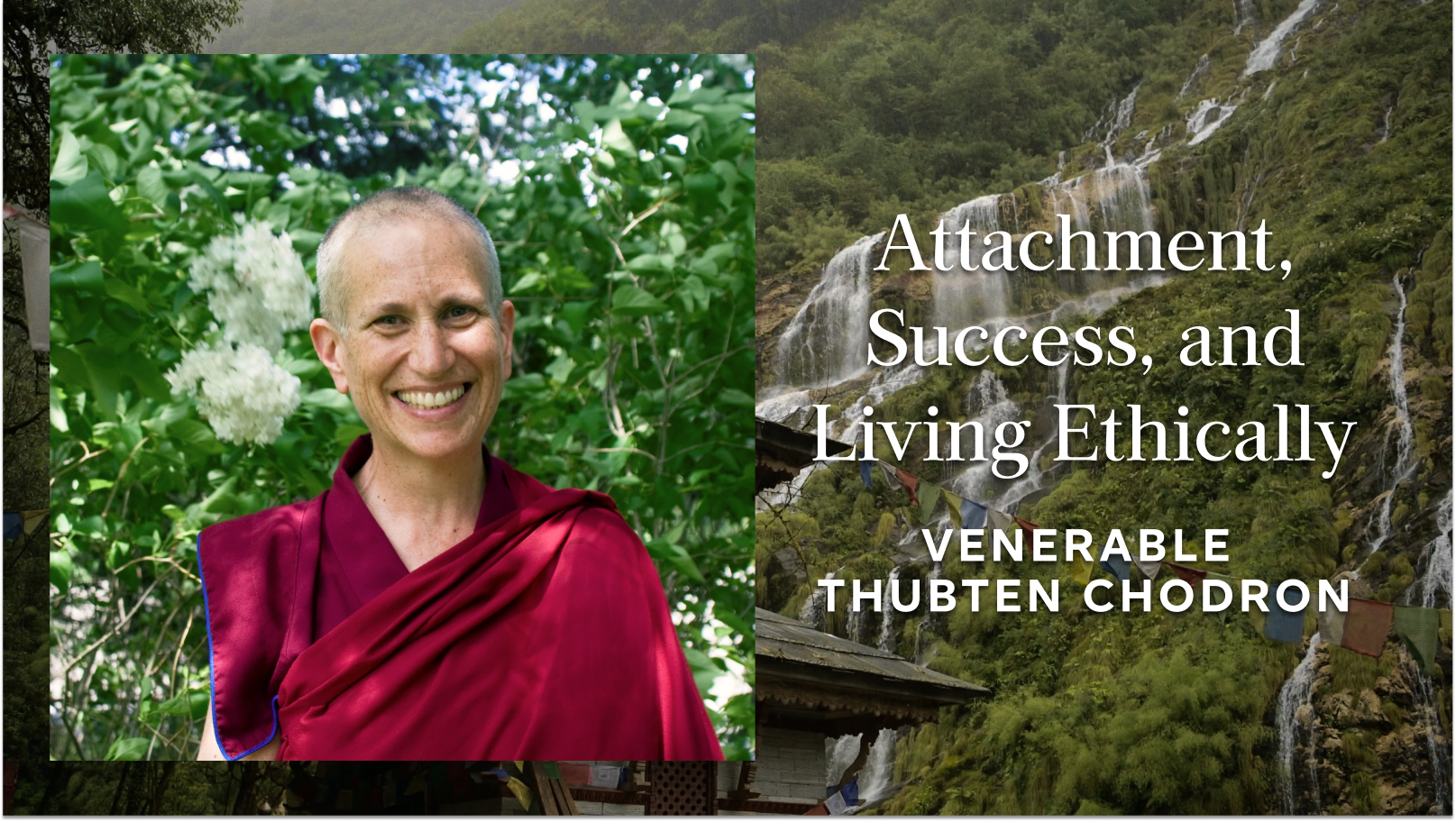
Venerable Thubten Chodron is an American Tibetan Buddhist nun, author, teacher, and the founder and abbess of Sravasti Abbey.
“I realized I had a double standard. Things I criticized other people for, I let myself off the hook.”
Listen on
Ven. Thubten Chodron shares her journey into Buddhism, explores ethical living, attachment, achievement, and the privilege of helping others. She offers practical wisdom for high achievers, reflections on wealth and freedom, and guidance on living a life of compassion and integrity.
Ven. Thubten Chodron shares her journey from questioning life’s meaning during the Vietnam War era to traveling across continents, discovering Buddhism, and embracing monastic life. In this wide-ranging conversation, she explores ethical living, dukkha (unsatisfactoriness), attachment, authentic happiness, and the privilege of helping others. She offers practical wisdom for high achievers, reflections on wealth and freedom (including a story about Bill Gates), and guidance on living a life of compassion and integrity.
Highlights
- “You don’t have to believe anything we say. Test it out. If it makes sense and helps you, continue. If it doesn’t, put it on the back burner.”
- “I realized I had a double standard. Things I criticized other people for, I let myself off the hook.”
- “Suffering is a horrible translation of dukkha. It includes more—the happiness that turns into pain, the body that inevitably dies.”
- “Helping is a privilege. Being able to do something for others that really affects their life in a positive way—then you feel good.”
- “Happiness isn’t what other people think, it’s how you feel about yourself.”
Ven. Thubten Chodron shares her journey from questioning life’s meaning during the Vietnam War era to traveling across continents, discovering Buddhism, and embracing monastic life. In this wide-ranging conversation, she explores ethical living, dukkha (unsatisfactoriness), attachment, authentic happiness, and the privilege of helping others. She offers practical wisdom for high achievers, reflections on wealth and freedom (including a story about Bill Gates), and guidance on living a life of compassion and integrity.
Highlights
- “You don’t have to believe anything we say. Test it out. If it makes sense and helps you, continue. If it doesn’t, put it on the back burner.”
- “I realized I had a double standard. Things I criticized other people for, I let myself off the hook.”
- “Suffering is a horrible translation of dukkha. It includes more—the happiness that turns into pain, the body that inevitably dies.”
- “Helping is a privilege. Being able to do something for others that really affects their life in a positive way—then you feel good.”
- “Happiness isn’t what other people think, it’s how you feel about yourself.”
Life Journey and Search for Meaning
- Grew up during the Vietnam War and in the shadow of the Holocaust.
- Asked: “What’s the purpose of my life and why are human beings killing each other?”
- Studied at UCLA, traveled across Europe, North Africa, Israel, Turkey, India, and Nepal.
- “So many people, different ideas, different ways of thinking… it really expanded my mind.”
Discovering Buddhism
- Graduate studies in education at USC; became a teacher.
- Found Buddhism through a meditation course in LA.
- “You don’t have to believe anything we say.”
- Drawn to critical thinking, logical testing, and meditation practice.
Becoming a Monastic
- Saw her own hypocrisy in ethical conduct.
- “I realized I had a double standard.”
- Ordained by Kyabje Ling Rinpoche in 1977.
- Parents struggled with her decision, but she found deep purpose in spiritual life.
Understanding Dukkha
- “Suffering is a horrible translation.”
- Three kinds: suffering of suffering, suffering of change, pervasive suffering of conditioned existence.
- Everyday examples: eating too much, falling in and out of love, inevitable aging and death.
Helping Others and Compassion
- “Helping is a privilege.”
- Empathy through imagining ourselves in others’ situations.
- Importance of both material help and long-term spiritual help.
- Compassion as the foundation of meaning.
Attachment, Goals, and Success
- Attachment = exaggerating qualities and clinging.
- “As soon as you plan something with all the exact details, now you know what will not happen.”
- High Achievers Neurotic Society—pressures of achievement.
- Success defined not by money or fame but inner integrity.
Wealth, Fame, and Real Freedom
- Story of Bill Gates and restricted freedom.
- “I can walk in the park. Bill Gates and his family can’t.”
- True happiness = ethical living, inner contentment, not social image.
Karma, Self, and the Rules of the Universe
- No permanent “I”—self is designated on body and mind.
- “My rules of the universe: everybody has to like me, everybody has to do what I want.”
- Self-centeredness breeds suffering.
Traveling the World, Expanding the Mind
Chodron recalls leaving UCLA to travel through Europe, North Africa, Israel, Turkey, and into India and Nepal. “So many people, different ideas, different cultures—it really expanded my mind.” This journey shaped her view of the world, exposing her to perspectives far beyond books. Her reflections show how travel, when approached with openness, can spark spiritual questioning and a desire to understand humanity’s deeper purpose.
You Don’t Have to Believe Anything We Say
When Chodron first encountered Buddhism, she was struck by a radical statement: “You don’t have to believe anything we say. Test it out.” This freedom to explore without dogma gave her space to think critically and embrace meditation as a method. For Chodron, this approach contrasted with rigid religious teachings she had rejected earlier, affirming Buddhism’s emphasis on direct experience, common sense, and logical inquiry.
Getting Ethical Conduct in Order
Chodron explains that part of her decision to ordain was recognizing hypocrisy within herself. “I realized I had a double standard. When others lied, I was furious. When I lied, I excused myself.” This self-reflection revealed the importance of ethical integrity, not just outward spirituality. Her journey highlights how Buddhism begins with facing one’s own mind honestly.
Success, Fame, Freedom, and Real Happiness
Chodron challenges society’s measures of success, recalling even meeting Bill Gates. “I can walk in the park—Bill Gates and his family can’t.” For her, happiness is not wealth or reputation but ethical living and inner peace. She emphasizes: “Success is not your money, it’s not your reputation. You can have all of that and be deeply unhappy.” Her teaching urges reevaluation of what really matters in life.
The Privilege of Helping Others
Chodron stresses that compassion is both practical and spiritual. “Helping is a privilege—being able to do something for others that really affects their life in a positive way.” While meeting material needs is essential, Chodron emphasizes guiding others beyond the cycle of suffering through wisdom and compassion. For her, the most lasting contribution is helping people uncover their inner freedom.
Keep browsing








Join the LWL Community


