



Browse Content



Life Worth Living is an initiative of the Yale Center for Faith & Culture at Yale Divinity School.


What is a human being and what is our place in the world?
Robin Wall Kimmerer on Reciprocity with Place
Life Worth Living Team
"It was through her actions of reciprocity, the give and take with the land, that the original immigrant became indigenous."
Listen on
"It was through her actions of reciprocity, the give and take with the land, that the original immigrant became indigenous."

Pairings
Our responses to life's big questions are meant to form a coherent whole—a vision of life worth living. A response to one question will fit well with certain responses to other questions, but it will be incompatible with others. We've provided the "Pairs Well With" and "Pairs Poorly With" sections for this article to help you consider these questions of coherence.
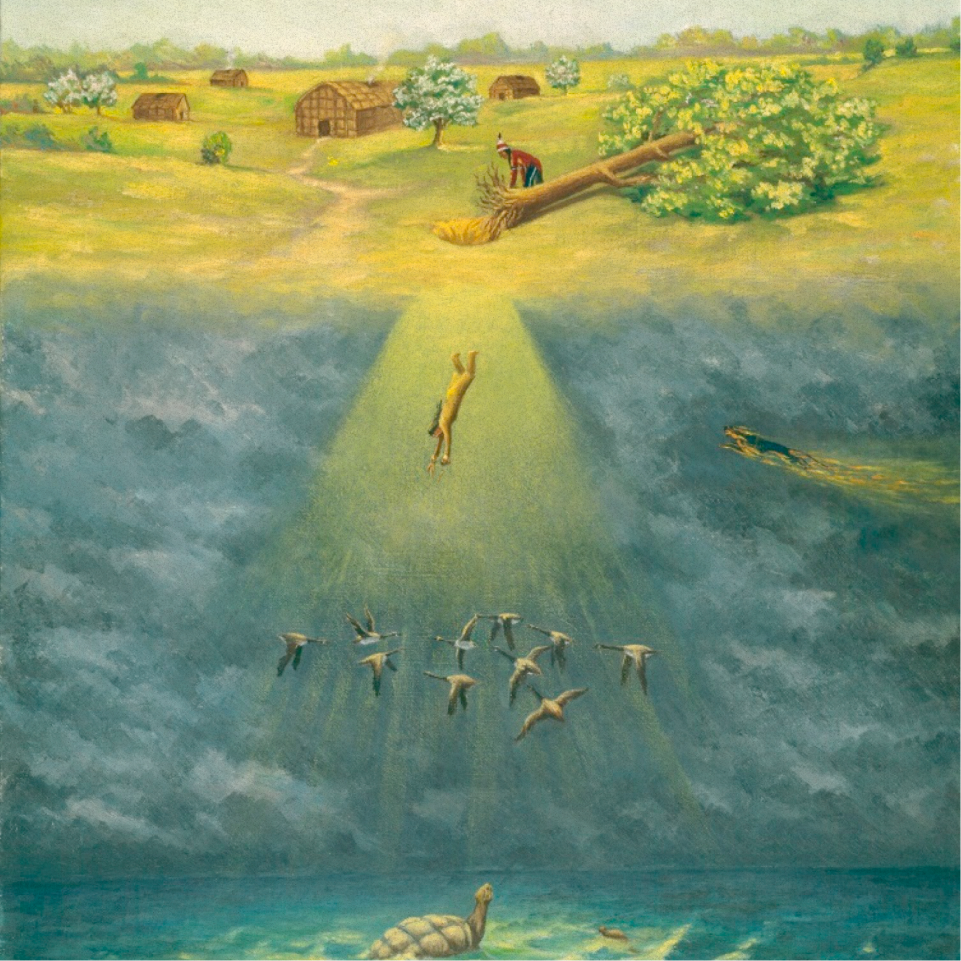
In her book Braiding Sweetgrass, Potawatomi botanist and author Robin Wall Kimmerer explores the role of humans within the natural world, considering both Western scientific mainstream systems of knowledge and North American indigenous knowledge systems. In this selection from Braiding Sweetgrass, Kimmerer narrates a Haudenosaunee origin story—the story of Skywoman, who fell from the sky and was caught and supported by the natural world upon her arrival. Kimmerer encourages her readers to consider Skywoman’s story in the context of contemporary American values:
[.alt-blockquote]It is also good to recall that, when Skywoman arrived here, she did not come alone. She was pregnant. Knowing her grandchildren would inherit the world she left behind, she did not work for flourishing in her time only. It was through her actions of reciprocity, the give and take with the land, that the original immigrant became indigenous. For all of us, becoming indigenous to a place means living as if your children’s future mattered, to take care of the land as if our lives, both material and spiritual, depended on it. In the public arena, I’ve heard the Skywoman story told as a bauble of colorful “folklore.” But, even when it is misunderstood, there is power in the telling. Most of my students have never heard the origin story of this land where they were born, but when I tell them, something begins to kindle behind their eyes. Can they, can we all, understand the Skywoman story not as an artifact from the past but as instructions for the future? Can a nation of immigrants once again follow her example to become native, to make a home?[.alt-blockquote]
[.alt-blockquote-attribution]-Robin Wall Kimmerer, Braiding Sweetgrass: Indigenous Wisdom, Scientific Knowledge, and the Teachings of Plants, pp. 8-9[.alt-blockquote-attribution]
Questions
- Do you think of humans as aliens to the natural world or as inherent to and a part of it?
- When, if ever, have you felt indigenous to a place? What was the context for this feeling?
- Are you indigenous to a place? If not, where would that be for you? What would it take to become so? What difference would it make in your daily life?
- How would your life have to change if you considered the present and future condition of the place and community where you live (or call home) as that which matters most?
Context
- Braiding Sweetgrass: Indigenous Wisdom, Scientific Knowledge, and the Teachings of Plants
- Chapter 8: “The Really Big Picture,” in Life Worth Living: A Guide to What Matters Most
Pairings
Our responses to life's big questions are meant to form a coherent whole—a vision of life worth living. A response to one question will fit well with certain responses to other questions, but it will be incompatible with others. We've provided the "Pairs Well With" and "Pairs Poorly With" sections for this article to help you consider these questions of coherence.
In her book Braiding Sweetgrass, Potawatomi botanist and author Robin Wall Kimmerer explores the role of humans within the natural world, considering both Western scientific mainstream systems of knowledge and North American indigenous knowledge systems. In this selection from Braiding Sweetgrass, Kimmerer narrates a Haudenosaunee origin story—the story of Skywoman, who fell from the sky and was caught and supported by the natural world upon her arrival. Kimmerer encourages her readers to consider Skywoman’s story in the context of contemporary American values:
[.alt-blockquote]It is also good to recall that, when Skywoman arrived here, she did not come alone. She was pregnant. Knowing her grandchildren would inherit the world she left behind, she did not work for flourishing in her time only. It was through her actions of reciprocity, the give and take with the land, that the original immigrant became indigenous. For all of us, becoming indigenous to a place means living as if your children’s future mattered, to take care of the land as if our lives, both material and spiritual, depended on it. In the public arena, I’ve heard the Skywoman story told as a bauble of colorful “folklore.” But, even when it is misunderstood, there is power in the telling. Most of my students have never heard the origin story of this land where they were born, but when I tell them, something begins to kindle behind their eyes. Can they, can we all, understand the Skywoman story not as an artifact from the past but as instructions for the future? Can a nation of immigrants once again follow her example to become native, to make a home?[.alt-blockquote]
[.alt-blockquote-attribution]-Robin Wall Kimmerer, Braiding Sweetgrass: Indigenous Wisdom, Scientific Knowledge, and the Teachings of Plants, pp. 8-9[.alt-blockquote-attribution]
Questions
- Do you think of humans as aliens to the natural world or as inherent to and a part of it?
- When, if ever, have you felt indigenous to a place? What was the context for this feeling?
- Are you indigenous to a place? If not, where would that be for you? What would it take to become so? What difference would it make in your daily life?
- How would your life have to change if you considered the present and future condition of the place and community where you live (or call home) as that which matters most?
Context
- Braiding Sweetgrass: Indigenous Wisdom, Scientific Knowledge, and the Teachings of Plants
- Chapter 8: “The Really Big Picture,” in Life Worth Living: A Guide to What Matters Most
Pairs Well With
- Certain natural law traditions
Pairs Poorly With
- Kantian ethics and its way of framing the individual as the prime locus of discernment of universal reason and truth
- Utilitarianism and its notion of equal responsibility regardless of proximity
Keep browsing



Join the LWL Community


